

Digital transformation in the finishing, dyeing, and weaving sectors of the textile industry demands a robust data architecture. As reflected in the global trends in weaving and finishing modernization, to achieve the Smart Factory model, production plants require IT systems that communicate frictionlessly. Often, the terms ERP, MES, and SCADA cause confusion regarding their scope and application. Understanding the specific functions of each software layer is the critical step to eliminating information silos, reducing bottlenecks, and ensuring rigorous cost control.
This guide breaks down the characteristics of each system, its position in the industrial architecture, and the exact moment when a textile plant needs to integrate each one to maximize its operational efficiency.
The smart factory architecture and the ISA-95 standard
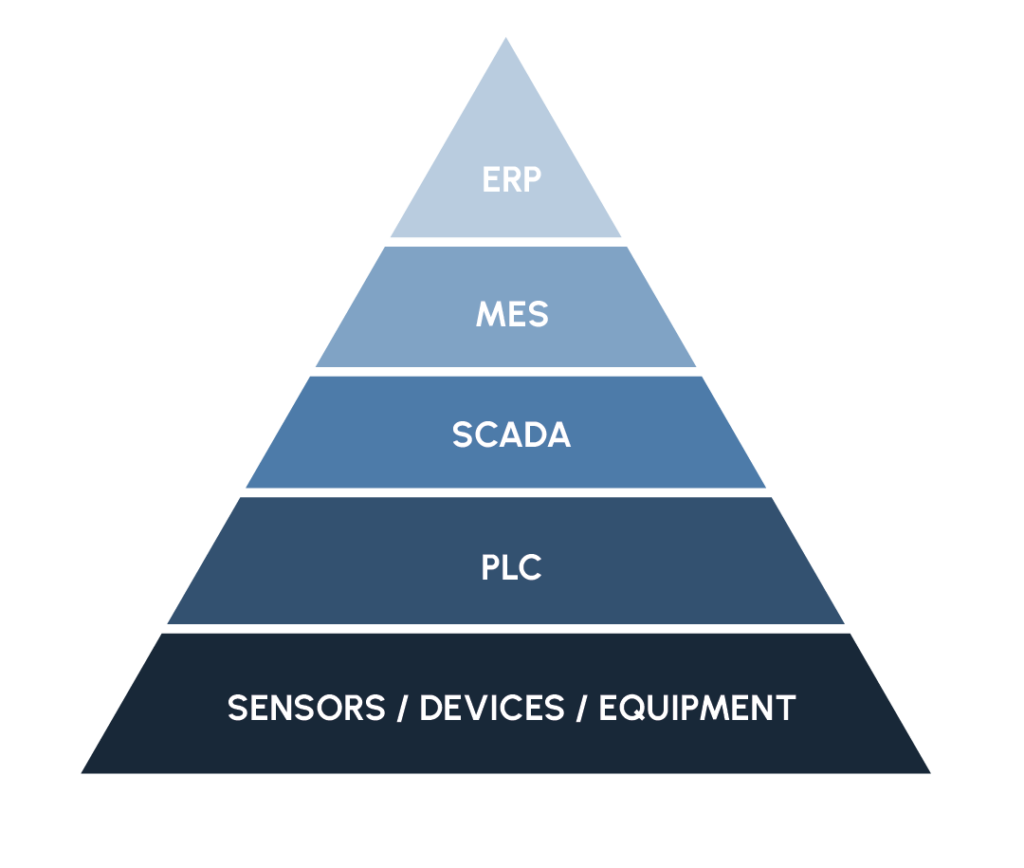
The international standard model ISA-95 establishes a clear hierarchy for integrating corporate and plant control systems. This structure, often known as the automation pyramid, divides operations into distinct technological levels.
At the base are sensors, actuators, and Programmable Logic Controllers (PLCs). As one ascends the pyramid, the focus shifts from real-time machine control to the company's long-term strategic planning. SCADA, MES, and ERP systems occupy the upper levels of this hierarchy, assuming clearly differentiated but complementary roles.
SCADA System: machine-level control and supervision
The SCADA (Supervisory Control and Data Acquisition) system operates at Level 3 of the industrial pyramid. Its primary function is to interact directly with machinery through PLCs, collect real-time physical data, and allow operators to supervise and control plant-level processes.
In the textile industry, SCADA is the bridge between electromechanical hardware and monitoring software. It does not make business decisions but executes technical orders with absolute precision and alerts to any physical deviation in the machines.
At the infrastructure level, the effectiveness of this system lies in its ability to speak the same language as the plant's hardware. For this data transfer to be secure and standardized, modern environments rely on industrial interoperability protocols like OPC UA. This technology connects PLCs from different manufacturers—such as those used in dyeing machines or stenter frames—with higher-level supervision systems, ensuring that information flows without interruptions or signal loss.
Main functions of SCADA in textiles
- Real-time Monitoring: Instantaneous visualization of temperatures, pressures, liquid levels, and speeds of dyeing machines or stenter frames.
- Alarm Control: Immediate notification of valve failures, pressure drops in boilers, or blockages in chemical dosing.
- Automation Execution: Direct management of washing, filling, and emptying cycles of dyeing machines.
When a SCADA is needed
A plant requires a SCADA system when manual machine supervision is inefficient and error-prone. If operators must physically check pressure gauges or manually adjust valves for each batch, integrating a SCADA is imperative to ensure safety, constant accuracy, and technical traceability at the machine level.
It is in this scenario that centralized monitoring software such as Atlantis It provides its true technical value. When implementing AtlantisThe plant unifies the control of all dyeing, finishing or stamping machines into a single interface. This ensures critical process safety, consistent accuracy in physical cycles, and immediate availability of technical data at the machine level, completely eliminating dependence on human visual verification.
MES System: dynamic plant execution and management
The MES (Manufacturing Execution System) occupies Level 3. It acts as the true brain of the production plant. While SCADA controls *how* a machine moves, MES determines *what* will be produced, *when*, *with what* recipe, and *who* will carry it out.
Sector-specific solutions such as InfoTint They are responsible for orchestrating all plant activity in real time, from the moment a production order is released until the finished product leaves for the warehouse.
Main functions of MES in finishing and dyeing
- Recipe and Production Route Management: Sending exact parameters (temperature curves, dye and auxiliary dosing) to machine controllers.
- Short-term Planning (Scheduling): Optimal assignment of batches to available machines, minimizing setup times and color changes.
- Quality Control and Traceability: Detailed record of each batch, operator involved, and process conditions, ensuring fabric tracking from raw material entry to final finishing.
- OEE Calculation: Precise measurement of availability, performance, and quality to identify unplanned downtime and continuous improvement opportunities.
When a MES system is needed
The need for a MES becomes evident when the plant relies on spreadsheets or paper documents to manage manufacturing orders. If production managers lack real-time visibility into batch status, or if preparing chemical recipes causes continuous delays and material waste, a sector-specific MES is the technical solution to stabilize production and optimize resources.
ERP System: comprehensive enterprise resource planning
The ERP (Enterprise Resource Planning) system operates at Level 4, the highest in the hierarchy. Its focus is not on the machine or the current batch, but on the business as a whole. ERP manages finances, purchasing, sales, inventory at a macro level, and human resources.
In a highly specialized environment, a generic ERP often falls short. Therefore, tools developed for the industrial fabric such as TexDrive They provide the necessary verticality, taking into account unique variables such as shrinkage, shrinkage, piece widths and color variations.
Main functions of ERP in the textile business
- Commercial Management: Creation of quotes, processing of customer orders, and invoicing.
- Long-term Planning: Material Requirements Planning (MRP) to ensure the supply of yarn, raw materials, or chemicals months in advance.
- Financial Management: Accounting, standard cost control, and profitability analysis by customer or product line.
- Global Inventory Management: Stock visibility across multiple warehouses, inventory valuation, and shipment management.
When an ERP system is needed
Every company that has moved beyond the micro-business phase requires an ERP. If invoicing information is disconnected from raw material purchases, or if calculating the profit margin of a production order requires hours of manual data collection across different departments, implementing an ERP is critical for the company's financial viability.
Comparison table of industrial software systems
To quickly visualize the areas of influence of each platform, the following table details their technical and operational attributes:
| Feature | ERP (e.g. TexDrive) ) | MONTH (Ex. InfoTint)<\/strong> | SCADA
/ Automation (e.g. Atlantis) |
| Main Focus | Business and Finance | Production Execution | Machinery Control |
| Time Horizon | Months, weeks, days | Days, shifts, hours | Minutes, seconds, milliseconds |
| Key Users | Management, Sales, Finance | Production Managers, Quality | Operators, Maintenance Technicians |
| Key Decision | What should we manufacture to be profitable | How to manufacture by optimizing the plant | Execute the physical process without deviations |
| Managed Data | Costs, orders, payroll, invoices | Recipes, routes, OEE, operators, batches | Temperatures, pressures, valve states |
The bidirectional data flow: ERP and MES integration
Maximum performance in a textile plant is not achieved by implementing these systems in isolation, but by ensuring continuous bidirectional communication. The true Smart Factory requires data to flow organically from the financial layer to the sensor, and vice versa.
When a sector-specific ERP like TexDrive is natively integrated with an advanced MES like InfoTint, the data cycle is perfected:
- Data Descent (From ERP to MES): The ERP receives the customer order and generates a manufacturing order. This order, with fabric and color specifications and deadlines, is automatically transferred to the MES. The plant system schedules the batch, assigns technical resources, and prepares the precise recipes for the color kitchen.
- Data Ascent (From MES to ERP): As the process advances (automatic dosing, dyeing, stenter drying), the SCADA informs the MES of the actual consumption of water, steam, and chemicals. The MES processes this data and sends it back to the ERP.
- Analytical Result: The finance department can compare the theoretical cost (calculated in the ERP) with the actual production cost (provided by the MES) to refine profit margins, ensuring absolute cost control based on real plant data.

Practical cases in textile dyeing and finishing
To materialize these definitions, we analyze real scenarios within the textile production flow.
Case 1: Optimization of color kitchen and dosing
In a printing plant, manual preparation of color pastes carries continuous risks of human error, tone variations, and waste of expensive products. By implementing a MES system with SCADA automation, the preparation order is sent directly to the automatic dispensers. The system calculates the exact quantity based on batch parameters and executes the weighing and delivery of the product to the machine without manual intervention. This ensures consistent color consistency batch after batch, drastically reducing waste and minimizing re-processing.
Case 2: Traceability control in finishing
During the heat-setting process in the stenter frame, variations in temperature or speed can alter the fabric's dimensional properties. A SCADA system monitors the frame's sensors and sends immediate alerts if values deviate from the parameters sent by the MES. All this thermal information is recorded and linked to the batch number in the MES. If a customer complains months later, the company can audit the exact historical record of the drying conditions for that specific roll.
Frequently Asked Questions (FAQ) about industrial software
Can I install a MES without an ERP? Technically possible, but not the optimal route. MES needs to receive manufacturing orders from somewhere. Without an ERP, this data must be entered manually, negating much of the data automation benefits.
Can ERP replace MES functions? No. Some ERPs include basic production modules, but they lack the technical capability to connect directly with PLCs, manage complex chemical recipes, or calculate OEE in real-time with millimetric precision.
How long does full ERP-MES-SCADA integration take? The timeframe varies depending on the plant's size and the prior standardization of processes. In industrial textile environments with EAS technologies, staggered integrations allow for the initial realization of technical and operational ROI within the first few months, with full project consolidation over a fiscal year.
Next step towards the smart factory
Competitiveness in today's textile industry demands abandoning information silos. Having the right software in the correct layer ensures the minimization of operational errors, optimization of energy and chemical consumption, and absolute control over business profitability.
The bidirectional integration between management and plant execution systems is the central pillar for exceeding the quality standards demanded by global brands.
Take the next step towards the comprehensive digitalization of your textile plant. Contact an automation and industrial software specialist at EAS. Our technical team will evaluate your factory's current architecture and design a tailored implementation plan.
Request a demo of TexDrive and InfoTint today and transform your data into performance.
