

Competitiveness in today's textile industry depends on speed of response, strict cost control, and optimization of available resources. Plants that still manage their production based on paper work orders or Excel reports reviewed at the end of the month operate with a critical disadvantage. The digitalization of the smart factory demands visual, agile, and centralized monitoring of production activity.
To successfully manage a modern dyeing, weaving, and finishing plant, it is essential to define and integrate automated Key Performance Indicators (KPIs). Implementing business intelligence tools allows for the transformation of machine readings into strategic financial and operational decisions.
The Role of KPIs in Textile Digital Transformation
Digitalization and the use of advanced analytics respond to an urgent need for global competitiveness. Stabilizing operating costs and optimizing machinery performance is the only way to adapt to global textile production trends, which indicate that data-driven efficiency and supply chain flexibility are the differentiating factors for leading plants in today's international market.
A textile KPI is a quantitative metric that evaluates the efficiency, quality, and economic performance of a specific process within the fabric manufacturing chain. Unlike raw production data, a key indicator provides immediate context to identify deviations from company objectives.
Real-time indicators allow a transition from reactive management, based on solving problems after they have occurred, to proactive management, where anomalies in energy consumption, material waste, or machine downtime are corrected the moment they arise.
To achieve this visibility, the integration of automation technologies is fundamental. Advanced analytical tools like TexView, the Power BI dashboard-based solution developed by EAS, collect information from the plant's MES and ERP systems to provide an accurate snapshot of the business status on any device.
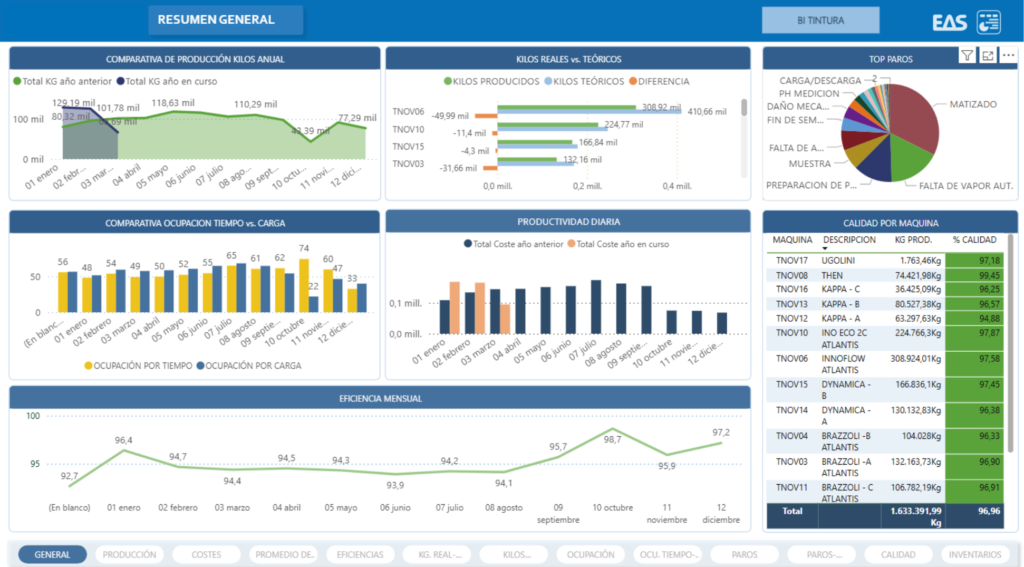
Critical KPIs in the Dyeing and Finishing Plant
The dyeing and finishing section is, by definition, one of the most complex areas due to the intensive use of water, chemical energy, and dyes, as well as the sensitivity of thermal processes. Indicators in this section should focus on process accuracy and financial sustainability.
Right-First-Time (RFT) Dyeing Rate
RFT measures the percentage of fabric batches that achieve the color and quality standard approved by the customer on the first production cycle, without requiring corrections, dye additions, or re-dyeing.
- Calculation formula: RFT(%) = (Lots approved on the first cycle / Total lots processed) x 100
- Importance: Low RFT exponentially increases operational costs. Re-dyeing doubles the consumption of water, chemicals, and machine occupation time, destroying the order's profit margin. Continuous monitoring helps isolate whether failures stem from an incorrect recipe or a variation in machine conditions.
Efficiency in Automatic Dyes and Chemicals Dosing
This indicator evaluates the accuracy and time taken by the automated color kitchen to prepare and send mixtures to the dyeing machines.
Measures the deviation between the grams of colorant requested by the management system recipe and the actual amounts dosed by the automatic equipment. Maintaining minimal deviation ensures color consistency between different batches without altering fabric properties. The integration of EAS automatic systems with analytical platforms allows for the detection of calibration faults in valves before they affect mass production.
Specific Water and Energy Consumption per Kilo of Fabric
This KPI relates the environmental and energy resources consumed to the actual volume of finished textile production.
- Unit of measure: Liters of water per kilogram of fabric (L/Kg) and Kilowatt-hours per kilogram of fabric (kWh/kg)
- Utility: Allows auditing the real impact of recipes and washing or heat-setting processes on stenter frames. An increase in this indicator suggests leaks in the facilities, inefficiencies in heat exchangers, or inadequate programming of machine loads.
Optimization in water and energy resource consumption is no longer just an internal savings strategy, but a direct response to international market regulatory demands. Aligning plant efficiency indicators with European textile industry strategies allows companies to anticipate sustainability regulations, facilitating the overcoming of environmental audits required by major global brands.
Fundamental KPIs in Weaving and Printing
In weaving rooms and printing lines (whether rotary or digital), profitability is directly linked to execution speed and machine continuity.
Overall Equipment Effectiveness (OEE) in Looms
OEE is the industrial gold standard for evaluating the productivity of heavy machinery. It breaks down performance into three critical factors: Availability, Performance, and Quality.
- Availability: Percentage of time the loom is producing versus the total planned time. Deducts downtime for yarn breaks, article changes, or maintenance.
- Performance: Actual weft insertion speed of the loom compared to the machine's nominal design speed.
- Quality: Meters of compliant fabric that meet technical specifications out of the total meters produced.
OEE (%) = Availability X Performance X Quality
Through interactive dashboards in Power BI, plant managers can visualize the overall OEE of the weaving department and filter data individually to discover which specific looms show mechanical bottlenecks or recurring problems with low-strength raw materials.
Defect Density per Linear Meter
Measures the number of physical defects detected in the fabric (dropped stitches, double picks, oil stains, warp breaks) during the inspection phase at the reviewing tables.
The goal of this indicator is to stabilize the process below the tolerance threshold agreed upon with the client, ensuring quality optimization without incurring excessive rejection costs. Early identification of an increase in defect density helps to stop an improperly adjusted loom in time, preventing the generation of kilometers of defective fabric.
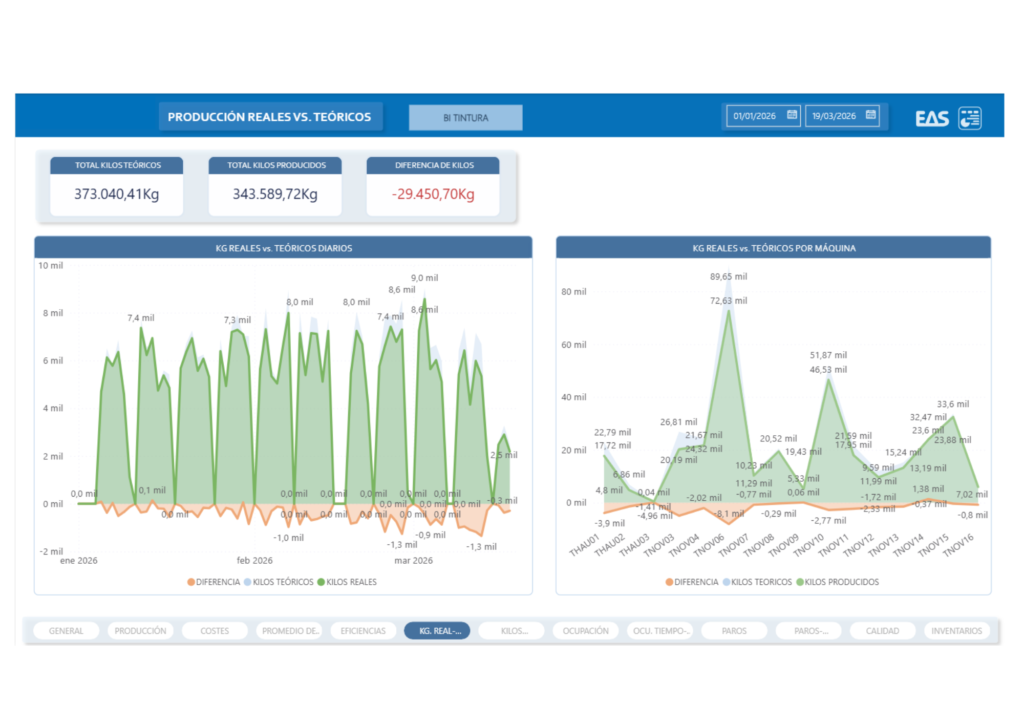
Economic Management and Industrial Cost Control KPIs
Technical efficiency must translate directly into financial profitability. Therefore, modern dashboards connect data captured on the factory floor with the company's accounting realities.
Standard cost deviation versus actual cost
This financial indicator calculates the difference between the estimated production cost of an article (based on the theoretical technical sheet of yarns, dyes, times, and energy) and the final actual cost recorded after its passage through the plant.
| Cost Component | Possible Deviation Cause | Corrective Action with TexView |
| Raw Material / Yarns | Excessive waste at loom startup. | Adjust warp lengths and programming. |
| Dyes and Products | Manual shade adjustments due to process error. | Review dye kitchen maintenance. |
| Energy / Steam | Waiting times with the machine hot. | Optimize load sequencing in the MES. |
| Labor | Extended downtimes due to article change. | Implement data-driven SMED methodologies. |
The use of analytics software such as TexView allows you to cross-reference the data of ERP TexDrive with the consumption measured by the system MONTH InfoTint. The result is the immediate visual identification of which specific orders or customers are reducing the company's real profit margin due to hidden inefficiencies.
System Integration: Data Flow between MES, ERP, and Power BI
The capture of key indicators cannot depend on manual data entry by operators, as this method introduces inevitable delays and human errors. The modern textile plant bases its analytics on a connected data infrastructure in three well-defined layers:
- Manufacturing Execution System (MES): The manufacturing execution system, such as InfoTint, physically connects to the PLCs of the dyeing and finishing machines. It records exact temperatures, cycle times, cooling curves, and dosages in real time.
- Commercial Management Layer (ERP): The TexDrive system manages manufacturing orders, theoretical costs of yarn inventories, dye stock, and delivery times committed to customers.
- Business Intelligence Layer (Power BI with TexView): Acts as the unifying brain. It extracts information from the previous two layers, cleans it, processes it, and transforms it into interactive and intuitive charts accessible to managers, production directors, and quality managers.
This bidirectional integration ensures that when an indicator shows an anomaly, the user can perform a detailed analysis (drill-down) from the overall company performance down to the specific manufacturing order or dye lot that caused the deviation.
Advantages and Recommendations of Advanced Monitoring
Implementing a structured KPI system using state-of-the-art analytical tools offers tangible benefits immediately, although it also requires an appropriate methodological approach to overcome initial technical challenges.
Main Advantages
- Unified visibility: Centralizes information from multiple departments (weaving, dyeing, finishing) in a single access point.
- Reduction of downtime: Allows for instant reaction to drops in loom performance or thermal deviations in stenters.
- Margin optimization: Facilitates the exact calculation of the cost per kilo manufactured, allowing for commercial rates to be adjusted to the plant's operational reality.
- Demonstrable sustainability: Provides reliable historical data on water and energy consumption, essential for audits and international certifications.
Implementation Recommendations
To ensure success in adopting these technologies, it is advisable to prioritize clarity over data volume. It is preferable to master and act on five critical KPIs than to saturate dashboards with fifty secondary metrics that dilute the management team's focus.
Furthermore, it is essential to involve plant personnel from the outset. Operators and supervisors must understand that the visual dashboards of TexView are not punitive control tools, but technological assistants designed to facilitate their daily work, eliminate repetitive administrative tasks, and ensure the stability of industrial processes.
Frequently Asked Questions about Textile KPIs
What is the difference between data from an MES system and Power BI dashboards?
The MES system focuses on operation, direct control, and recording of machine mechanical and chemical events minute by minute. Power BI takes this massive volume of historical data, combines it with financial information from the ERP, and presents it in aggregated visual dashboards geared towards strategic direction and cost optimization.
How does data analytics help reduce energy costs in finishing?
Through tools like TexView, it is possible to correlate the gas or electricity consumption of finishing stenters with fabric types and idle times between batches. This helps identify if machines are kept at high temperatures without producing, aiding in efficient workload reprogramming.
Is it complex to integrate TexView if we already have machinery of different brands and ages?
No, the advantage of EAS solutions is their ability to interact with heterogeneous machinery fleets. The interfaces and automation solutions unify signals from different PLCs, allowing Power BI to receive standardized data regardless of the manufacturer or age of the loom or dyeing machine.
Maximize your textile plant's efficiency with real data
Intuitive control in textile manufacturing has reached its historical limits. Companies leading the market today base every operational decision on consolidated, accurate, and real-time visualized data.
Implementing the right combination of KPIs in dyeing, weaving, and finishing is the definitive step towards the smart factory. The advanced dashboards of TexView, backed by EAS's industrial automation expertise, transform the complexity of your factory floor into simple, actionable, and profitability-oriented dashboards.
Achieve a complete and transparent view of your costs and production yields.
- Request a personalized demonstration of TexView to see how Power BI works with your plant's real data.
- Contact a textile digitalization specialist to design a KPI strategy tailored to your needs.
- Request detailed information about our comprehensive automation and MES/ERP software solutions.
