

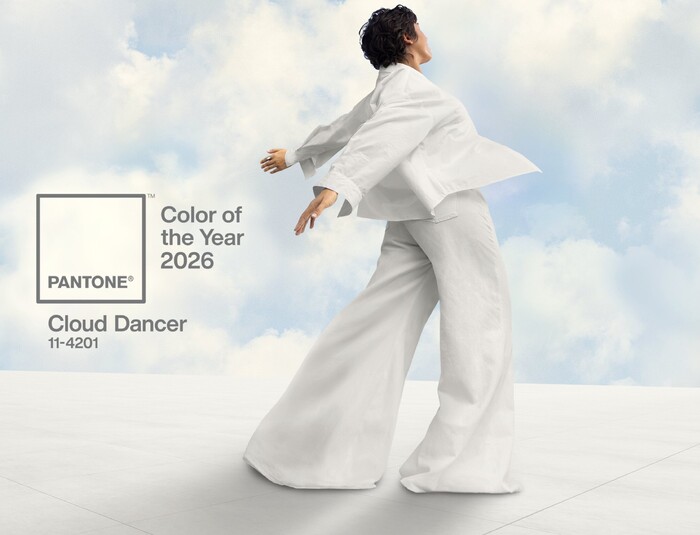
This year, Pantone took an unexpected turn by announcing, for the first time, a white as the Color of the Year: PANTONE 11-4201 Cloud Dancer. It is not just any white; it is described as an “airy, ethereal hue with a soft, calm presence.” In other words, a color that seeks to convey serenity, mental clarity, and the feeling of starting from a “blank canvas” in a world increasingly saturated with visual stimuli.
According to the Pantone Color Institute, Cloud Dancer aims to act as a bridge to a kind of visual and emotional respite. The proposal is clear: simplify, slow down and open space for a more functional creative renaissance. And, as is often the case with the Color of the Year, its impact goes far beyond aesthetics.
In fashion, decoration and interior design, this white already stands out as a symbol of contemporary minimalism, purity and chromatic versatility. But the important question is: what does this really mean for the textile industry?

1. A change in the palette that really has consequences
When a color becomes a global trend, the demand for that shade multiplies. And, in this case, we are not just talking about a “pure” white, but about the entire family of whites, raw and off-white.
Brands already planning their collections for 2026–2027 have started adjusting their palettes. This will translate into an increase in orders for white fabrics, a greater need for stock, more purchases of fibers, chemicals and bleaches and, above all, a greater demand for consistency.
Those who anticipate will be able to attract important contracts or ensure large production volumes. Furthermore, this is not limited only to the fashion sector: the home, hospitality and decoration market also relies heavily on neutral fabrics, further expanding the market potential.

2. White - a simple color... until it's time to produce it
On a technical level, white is one of the most complex colors to work with. It may seem contradictory, but a small variation is enough for the final tone to acquire grayish, yellowish or bluish nuances. And, in industrial series, these variations are critical.
The main challenges are:
- Variability of raw materials: different fibers react differently. Change the lot, change the target.
- Very sensitive processes: pH, temperature, times, chemical concentration... Any fluctuation alters the result.
- Increasing orders under pressure: when the market demands more white, there is less room for error and greater risk of returns.
Therefore, this color trend requires stable processes, precise data and millimeter control. It is not enough to “make white”; It is necessary to do it the same, always.
Automation: the key to harnessing the Cloud Dancer wave
For a company that works with textile automation —whether in dosing, dyeing, finishing or plant management— Cloud Dancer can become a concrete competitive advantage. It's not just about following fashion: it's about demonstrating that your plant is prepared to reproduce a target with surgical precision.
Ability to adapt to demand peaks
When the trend triggers orders, an automated plant can increase the pace without sacrificing quality or generating waste.
Automatic dosing of dyes and chemicals
By eliminating human variability, recipes are executed accurately. This is crucial when any deviation impacts the final tone.
Control of critical parameters
Automation keeps temperature, pH, times and flows constant. The result: fewer stains, fewer “dirty” tones, fewer differences between batches.
Laboratory connected to the plant
If the recipe works in the lab, it should work the same way in production. Integrating both worlds guarantees reproducibility and trust for the client.
Complete traceability
MES/ERP systems allow each batch, each parameter and each incident to be documented. In outsourced or institutional sectors, this transparency is an argument of great value. In contracted setors or institutions, that transparency is a compelling argument.
How to prepare to take advantage of the trend
If you want to position yourself as a trusted provider in the midst of Cloud Dancer fever, these steps are essential:
- Communicate your preparation: showing technical ability and consistency can open doors with demanding brands and buyers.
- Review current capacity: know how much white you can produce today and how much you could take on in case of large orders.
- Carry out fiber pilot tests: cotton, polyester, blends, technical fibers... each requires specific adjustments.
- Strengthen quality controls: reflectance measurements, batch-to-batch consistency, and process logging.
- Plan inputs in advance: suppliers will also have demand spikes. Whoever gets ahead will have the advantage.
What happens if this change is not taken seriously?
There are clear risks:
- Loss of opportunities if customers are looking for more reliable suppliers.
- Greater probability of unstable tones in manual or semi-manual plants.
- Delays due to lack of chemicals or bleaches.
- Increased losses and reprocessing if demand suddenly grows.
Beyond White: What Cloud Dancer Really Reveals
This color does not stand out only for its aesthetics. It is the symptom of something deeper:
- A market that seeks calm and simplicity.
- Consumers who value neutrality and versatility.
- The return of minimalism as the basis of design.
- Preference for durable, essential and easy-to-integrate colors.
For the textile industry, this means that the value is not only in following eye-catching trends, but in mastering the production of impeccable basics. And that's where automated processes make a real difference.
Cloud Dancer: an aesthetic trend with industrial impact
PANTONE 11-4201 Cloud Dancer is not just a pretty white. It is a strategic signal. It represents an opportunity for textile companies with advanced technology to demonstrate their ability to produce with precision, consistency and efficiency.
The underlying message is clear: if your plant can produce perfect targets, it can produce virtually anything. The 2026 Color of the Year chosen by Pantone conveys calm and clarity. In the industrial world, this translates into control, repeatability and operational excellence.
A field where automation not only adds up: it becomes indispensable. If you need guidance to automate your plant and quickly implement new trends in your production, count on us.
